
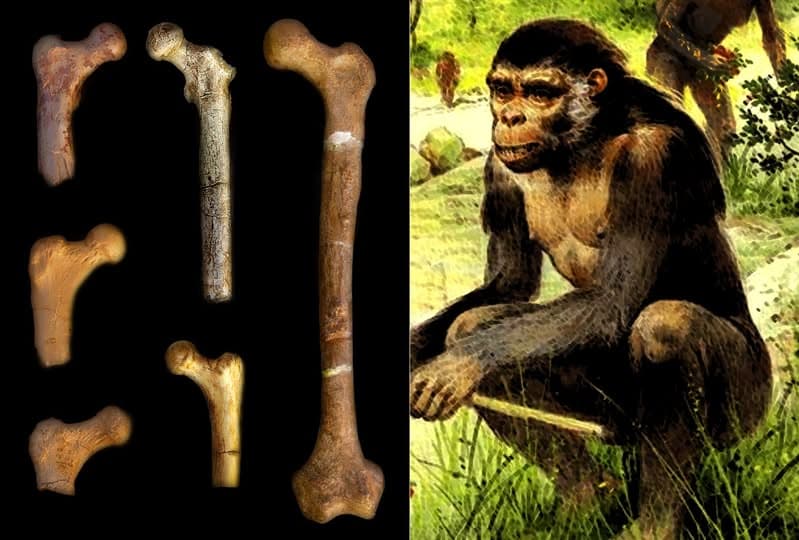
The word aurorin in Kenyan local language means "human of origin" and is one of the chimpanzees-sized primates. We identified it "with a collection of bone fragments that include only the bones of the hand, thigh, lower jaw and some teeth" (Figure 2.3). Once discovered, it...
2 Ororin fossils Tugenensis.
In the local Kenyan language, the word aurorin (anthropomorphic), a chimpanzee-sized primate, means "a collection of bone fragments that includes only the bones of the hand, thigh, lower jaw, and some teeth" (Figure 2.3). Once discovered, the New York Times ran a piece entitled "The fossils that may be the earliest human connection"31 and declared that they "may be the earliest ancestor of the human family."32
Some human palaeontologists claim that the Ororin femur indicates that it is "an object that walks on the ground erect on two legs, which is consistent with the characteristics of the group present at the beginning of the human lineage", but Yale University later published: "However, there is now a small precious evidence of how the Ororin walked."
Evolutionary paleontologists assume that walking on two legs is the definitive test of a species' belonging to the line of human evolution, but if the ape-like orion has been walking upright on two legs for more than six million years, does that recommend it as a human ancestor?
Not at all, but in the fossil record many apes erect on two legs, which evolutionists classify as far away from the line of human evolution, and in 1999 biologist Christopher Wells of the University of San Diego noted that: "The upright position is not concerned with our evolutionary line, there is a monkey that lived 10 million years ago on the island of Sardinia (known as Oreopithus bambolii 36) separately."
A more recent article in ScienceDaily proves that this ape's fossil "appears to have many similarities to early human ancestors, including features of a skeleton that seems to have been adapted to walking on two legs, and the authors note that we know enough about the anatomy of this organism to know that it is a distant relative of humans, but that it has acquired these human-like features independently."[37]
A 2011 paper by Bernard Wood and Terry Harrison in Nature explains the demands of erect monkeys on two legs that have nothing to do with the origin of humans: "The typical finding we get from Oreopithecus is to reject the claim of an evolutionary relationship between the two alleged early hominins, and we conclude from it that traits that are specific to humans may be acquired by some monkeys independently within an evolutionary line."
Just as Toumai's skull threatened to knock out the southern apes (Australopithecines) from our evolutionary line, acceptance of the hypothesis that the orion is one of our ancestors also means that it is "just an extinct lateral branch of hominid evolution", according to Hominid and colleagues.
While Orrin suggests to human paleontologists that the erect creature, which lived at the time of humans’ separation from chimpanzees, could appear in their common ancestor, we know little about it to make firm claims about its ability to walk the Earth or its true place within the supposed tree of evolution.
More: https://braheen.com/publications/العلم-وأصل-الإنسان
—
Source: Published on Facebook's "Braheen Center" page
https://www.facebook.com/braheen.org/posts/pfbid02yjT687SeYGk4KdFzkJN8UytS2RpzNW5SViHCkrZiyC8BFnHxJxCU1zyap4efkSdxl