
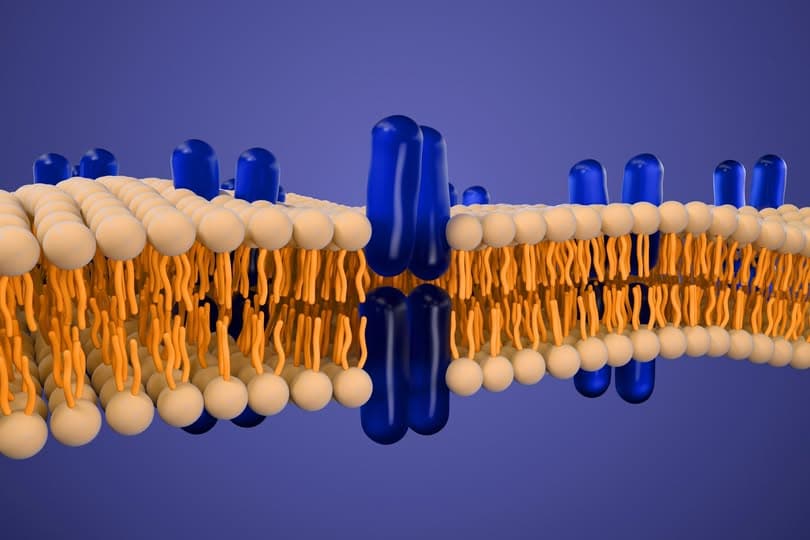
The cell membrane is made up of particles that oscillate familiarity (double familiarity) towards water, thus similar to soap and disinfectants used in house cleaning. The word (double familiarity amphiphiphilic) is derived from the Greek root...
The cell membrane is made up of particles that are oscillating towards the water, similar to soap and disinfectants used to clean the house. The word “amphiphilic” is derived from the Greek root meaning “he loves them both.” The molecule with double affinity likes two different environments: water and oil, and the shape of the molecules is very similar to a sucker candy with two sticks coming out of it on the same side to resemble a candy ball. Chopsticks often consist of hydrocarbon chains – made of atoms of carbon and hydrogen – and like any other hydrocarbon such as gasoline, they do not mix with water, and this is the oil-loving part of the molecule. Such areas of the molecule are called hydrophobic (fear of water). The ball-forming molecule in this sucker candy is generally made up of a chemical group, such as table salt or sugar, that enjoys being in the water; Both parts of the membrane-forming molecule are linked together as Siamese twins, and they have to stay together despite the different qualities, but if one part of the molecule wants to stay in the water and the other wants to get out, how does it settle down?
Two-compassionate molecules get rid of this mess by binding to each other by binding to other two-compassionate molecules. When a large number of two-compassionate molecules bind, the hydrophobic tail gathers to expel the water while the hydrophilic heads meet the hydrophilic page, an effective way for the tails to fortify themselves against the water while allowing hydrophilic groups to access the water and form a bilayered bubble.
- Dr. Michael Behe.
More: https://braheen.com/publications/صندوق-داروين-الأسود-تحدي-الكيمياء-الحيوية-للتطور
—
Source: Published on Facebook's "Braheen Center" page
https://www.facebook.com/braheen.org/posts/pfbid0ch2ckXBMSgJ8JCGjTnM3tTRPk1EikDR8b43PdhRnqhuM4zLQ6EoJHQsf3FqaWon4l