
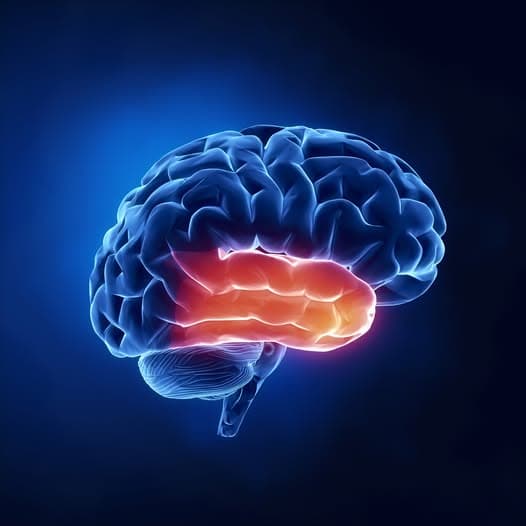
The temporal lobe is part of the cerebral cortex, which is the outer layer of the brain that has a pivotal role in performing higher cognitive functions; such as cognition, thought, and memory. The cerebral cortex is divided into four main lobes,...
The temporal lobe is part of the cerebral cortex, the outermost layer of the brain that has a central role in performing higher cognitive functions; such as cognition, thought, and memory.
The cerebral cortex is divided into four main lobes, one of which is the temporal lobe. The temporal lobe is located below the lateral fissure, a deep groove that separates the temporal lobe from the frontal lobe and the parietal lobe.
The temporal lobe is located on both sides of the brain, and is involved in various functions related to sensory processing, memory, language, and emotions. One of the primary functions of the temporal lobe is to process sensory inputs such as vision, hearing, and touch, and to derive meaning from them. For example, when we see an object, the visual information is processed in the primary visual cortex, which is located in the occipital lobe. However, to recognize the object and assign meaning to it, the information is further processed in the temporal lobe.
The temporal lobe is also involved in visual memory retention, which is the ability to remember visual information such as faces, places, and objects. Individuals who have suffered damage to this area of the brain may have difficulty remembering visual stimuli. However, this disability is not due to a lack of perception of visual stimuli, but to an inability to interpret what is perceived. This means that the individual may see something but not be able to recognize or remember it.
The most common symptom of inferior temporal lobe damage is visual blindness, a condition in which an individual finds it difficult to identify familiar objects. For example, they may see a stenosis but cannot recognize it as a writing tool. Another less common symptom of inferior temporal lobe damage is prosopagnosia, a impairment in facial recognition and the ability to distinguish unique individual facial features. This means that an individual may have difficulty recognizing familiar faces, including those of family members and friends.
Temporal lobe epilepsy is one of the most common diseases related to the temporal lobe. This condition causes frequent electrical attacks and can lead to symptoms such as hallucinations related to the senses of sight, voice, smell and taste. In addition, individuals with temporal lobe epilepsy may have difficulty processing certain types of memories, including semantic and episodic memories.
There is a relationship between schizophrenia and the temporal lobe; the deficit in the left temporal lobe, specifically within the primary auditory cortex, is attributed to the perception of external sounds in auditory hallucinations, which is one of the most pronounced symptoms of schizophrenia. Low gray matter and other cellular deficits in spontaneous neural activity contribute to the influence on the primary auditory cortex, leading to speech distortion and perception of external sounds in schizophrenic patients.
—
Source: Published on Facebook's "Braheen Center" page