
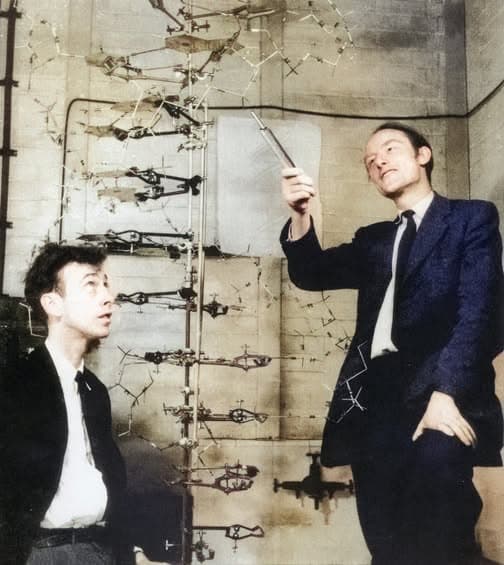
Three teams were racing to solve DNA structure puzzles that most biologists today assume will help explain how genetic traits are passed from one generation to the next.
Three teams were racing to solve the DNA structure puzzles that most biologists today assume will help explain how genetic traits are passed from one generation to the next, and the world expected to win this race was the Nobel laureate Linus Pauling, followed by a majestic team of Cambridge University scientists headed by Lawrence Bragg and Max Perutz. Away from the race.
At a time when London team leader Maurice Wilkins and X-ray specialist Rosalind Franklin were pursuing the tedious work of collecting data on the mysterious molecule, Watson and Crick seemed to be playing with the illustrations, one of which Rosalind Franklin mocked when she showed them, and based on her deep knowledge of the X-ray images she had taken of the distant DNA crystals, she soon convinced Watson and Crick that they were all there.
Who are these two? Watson, with the intricate hair and a willingness to give up work to watch a movie, and the elegant Crick who began to outgrow my young age, and yet never seemed to finish his thesis, so that their place in the lab was removed at some point, but they eventually went back to their lab, and if we peeked into Cavendish Labs a few months later, what we see would not feel confident; Crick had not yet arrived, and Watson was sitting on his hair.
But in the end, they sparked the revolution, the molecular biology revolution as it came to be called, that will redefine the nature of life by highlighting the importance of information for the inner minutes of living things, and will also reframe the questions that life researchers must answer from now on.
- Dr. Steven Meyer.
—
Source: Published on Facebook's "Braheen Center" page