
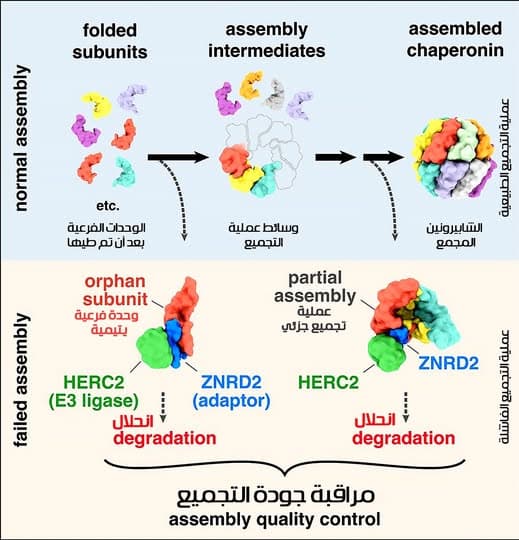
A research group from the Medical Research Council Laboratory of Molecular Biology in Cambridge recently published an article in the journal CELL about "the mechanism of orphan subunit recognition during assembly quality control", the paper discusses the mechanism of protein subunit recognition...
A research group from the Medical Research Council Laboratory of Molecular Biology in Cambridge recently published an article in the journal CELL on the "Mechanism of Orphan Subunit Identification during Cluster Quality Control", the paper discusses the mechanism of identification and elimination of orphan subunits during cluster quality control in cells. The study focuses on the identification of orphan subunits of Shapironin (or accompanying protein) CCT and the employment of the enzyme E3ubiquitin lipase E3 ubiquita.
Cells contain many molecular machines that are made up of multiple subunits.
Sometimes problems can occur during assembly of these machines, which may result in orphan protein subunits.
Orphan protein subunits are subunits; they are not part of a fully assembled protein machine and can be harmful to the cell if left unrecognized.
The paper focuses on how to identify those orphaned subunits in a particular molecular machine called cytosolic chaperonin or CCT and how to eliminate them.
The researchers found that several uncombined CCT subunits work together to recruit the enzyme e3ubiquitin to be called HERC2 using another protein called ZNRD2 as a transducer.
The roles of both HERC2 and ZNRD2 proteins are essential in knocking down orphan CCT subunits in cells in order to achieve optimal cell fitness.
The researchers used domain mapping and structure prediction to determine the molecular features of the lower HERC2-ZNRD2-CCT module. They also created a structural model for this module and validated its key elements in cells using point mutations.
The structural model explains why ZNRD2 selectively recognizes many orphan CCT subunits without involving properly assembled CCT machines. The results of this study provide insight into how failures are monitored during CCT assembly and provide a model for molecular recognition of orphan subunits, which are the largest source of quality control substrates in cells.
According to the researchers, the findings could have implications for our understanding of cellular balance, protein toxicity, aging and cancer. The study could also pave the way for the development of new treatment strategies for these diseases.
Specifically, the paper suggests that in the future, the alternative pathways used to eliminate CCT3 and CCT6 orphan subunits should be further investigated. Whether the subsequent formation of the Ubiquitin chain with another factor(s) is required to replace the CCT subunits is to be determined. It also suggests the validation of the structural model proposed in the paper if the experimental methods are correct.
—
Source: Published on Facebook's "Braheen Center" page