
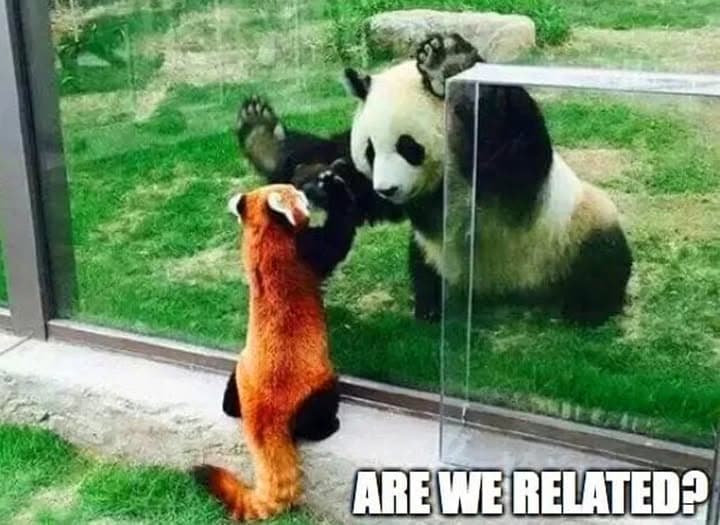
Or to convergent evolution in parallel lines without a common ancestor? The giant panda and the small red panda are the best examples of the problem of differentiating between structural similarities and functional similarities. Both panda species are...
Does the similarity indicate a regression from a common ancestor?
Or to convergent evolution in parallel lines without a common ancestor?
The giant panda and the small red panda are the best examples of the problem of differentiating between structural similarities and functional similarities. Both panda species are endemic to the bamboo forests of southwestern China. For more than a century, scientists who study the two panda species have not been able to agree on their classification into the bear family or the raccoon family.
In 1964, the head of the vertebrate anatomy department at the Chicago Museum of Natural History (Dwight Davis) published an idea that later became widely accepted to solve this problem and influenced most biologists.[1] Davis concluded that giant pandas are not raccoons but bears, while small pandas are raccoons, not bears.
If the red panda is a raccoon and the giant panda is a bear, the red panda will be the only raccoon living outside the Western world (the Americas). But the presence of a single raccoon confined to China has surprised many biologists. The most compelling thing at the time was to consider both pandas as raccoons or bears.
In addition to living in the same place, giant pandas and small pandas share a large number of physical and behavioral traits. For example, they have a nose similar to each other, as well as the upper jaw. Note the small size of the nose compared to the polar bear and how the bones of the upper jaw widened from the back. Both pandas have large grinding teeth and large chewing muscles that work to fit these new traits.
These similarities are clear even to a general observer and there are other similarities that are harder to detect. The type of pandas in the stomach, gut, and liver are similar and different from the rest of the bears. Darwinists consider the common diet of bamboo to be the cause of these digestive similarities, at least in part. But this is not the end of the pigment of the giant pandas genetically with 42 pigments to be closer to the number of pigments of red pandas.
Giant pandas are known among biologists for their thumbs, which gives them a versatility that other bears do not have. This thumb can meet the rest of the fingers, although it is not a full thumb and is able to partially meet the other fingers. It turns out that this thumb is an enlarged bone of the panda's wrist known as radial sesamoid. The bone assembly of the panda's wrist works harmoniously.
Small red pandas also have enlarged sesamoid bones and are used to handle and exfoliate bamboo, although they are not as obvious as giant pandas. Not only do they resemble the shape of the bone, but their whole system and supporting structures, such as the special position of the tendons of the distal muscle, as well as the bone surfaces of the wrist. In addition, giant pandas and red pandas have many other behavioral similarities.
The two panda species share many common traits, which is a convincing proof, at first glance, of their similarity to a common ancestor. Biologists even considered these similarities to be homologous structural similarities and interpreted them as descendents of the common ancestor, and classified Dubai pandas in the same family. But suppose that we accept the current trend among biologists in considering each species of panda to belong to a different family from the other, but these similarities are not the result of the same function. Such incidents, which are many in nature, raise the question of whether similar traits can be adopted as evidence for evolutionary relationships.
- Dr. William Dembski and Dr. Jonathan Wells
From The Design of Life.
(1) D. D. Davis, The Giant Panda: A Morphological Study of Evolutionary Mechanisms (Chicago: Field Museum of Natural History, 1964).
—
Source: Published on Facebook's "Braheen Center" page
https://www.facebook.com/braheen.org/posts/pfbid0aVFcsQ93FU4rVHmvqiCk44qzep5PcBJ94DTJhXQgxkf7npBdMqL7BVPCfxvxHquLl