
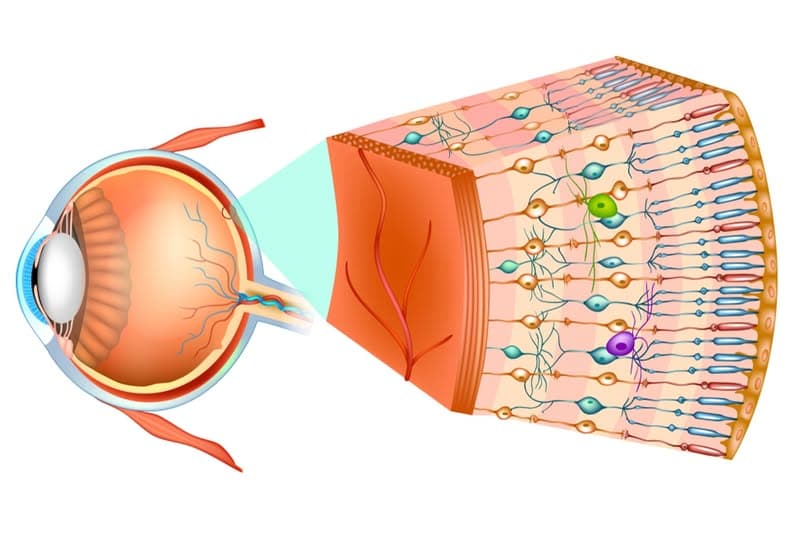
The two basic types of light-sensitive cells in vertebrate retina are sticks and cones. The latter are very sensitive to light and function well in dim light or at night. They can actually sense even a photon...
The two basic types of light-sensitive cells in vertebrate retina are sticks and cones. The latter are very sensitive to light, and function well in dim light or at night. They can actually sense even a single photon, but only see black and white. The number of cones is much smaller than sticks, and they are not sensitive to light, but they see colors.
Both sticks and cones require large amounts of nutrients and a tremendous amount of energy. One classic book of the eye describes them as "greedy".7 In mammals, they have the highest metabolic rate of all body tissues.8. About three-quarters of the eye's blood supply flows through a dense network of capillaries called the placental capillaries, on which they lie behind the retina.(10) The oxygen and nutrients, including the modified vitamin A, transport the capillaries.
In addition to transporting oxygen and nutrients, the pigmented epithelial layer performs another basic function. The rods and cones contain heaps of disks that are packed with light-sensitive chemicals. During the light-sensing process, toxic chemicals are formed that must be disposed of so that the light-sensitive cells continue to function.
Dr. Jonathan Wells
—
Source: Published on Facebook's "Braheen Center" page
https://www.facebook.com/braheen.org/posts/pfbid02xqo3VV6MG9U9oPkHbJb3YtDAfuvRqPwRSMAeAvrSSnqbqdKMTtFMriRimk7UTNH9l