
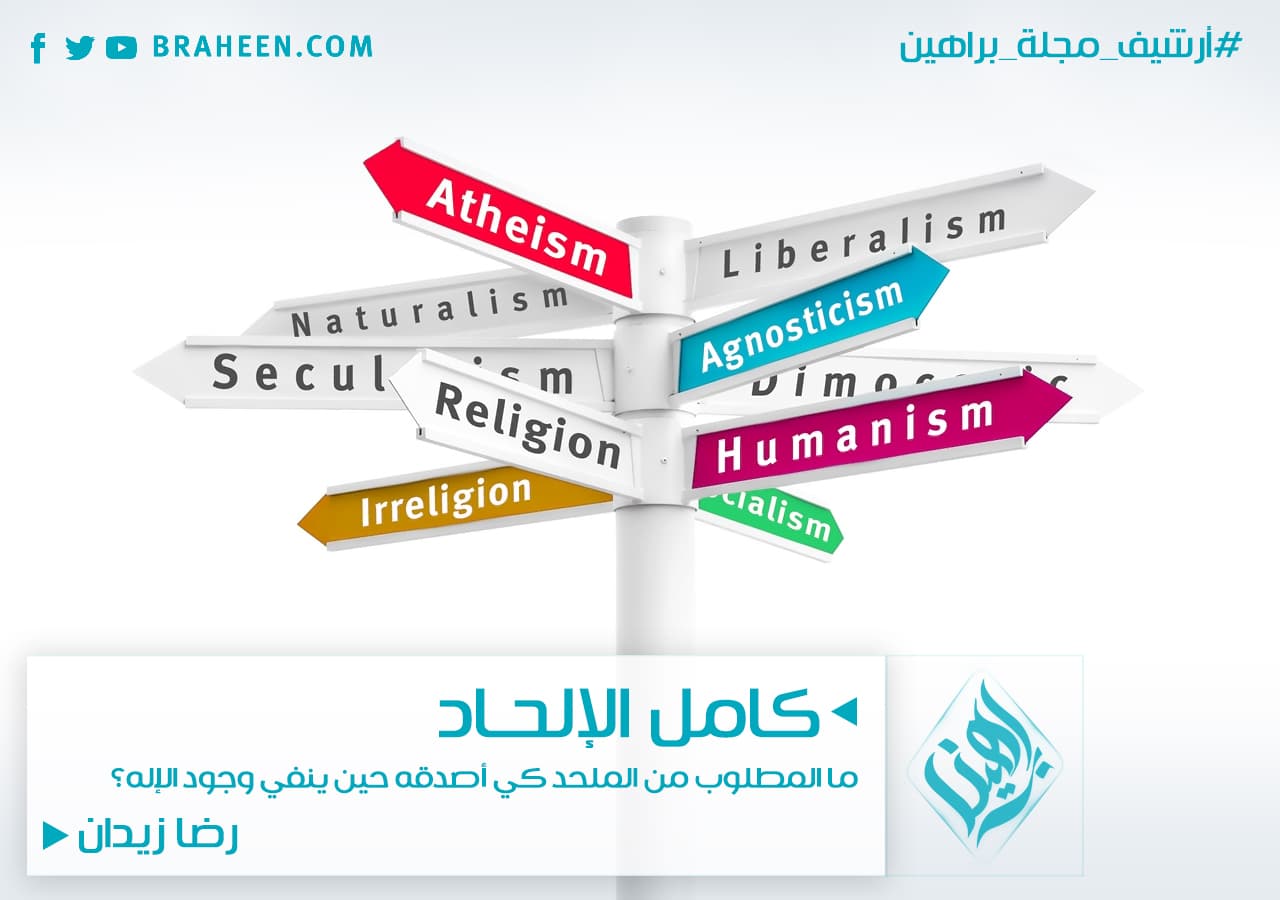
Is atheism easy? What is required of an atheist to believe when he denies the existence of God? Are there qualifications - or less concessions - psychological to become a person who does not believe beyond the material truth? The question can be formulated in the form of an emerging atheist: What should I do to be an atheist...
Complete Atheism: What Must an Atheist Provide for Me to Believe the Denial of God’s Existence?
Is atheism easy? What is it necessary for an atheist to believe when he denies the existence of God?
Are there psychological qualifications, or concessions, to become an honest nonbeliever beyond the material?
The question can be put in terms of an emerging atheist: What should I do to be an atheist?
There is no doubt that complete atheism mentally and psychologically no matter what a man can do to reach him, just as the perfection of good is very rare in humans represented in the prophets; just as the perfection of evil is the same! Just as the believer struggles with evil in himself in order to increase his faith; the atheist will need to strive with good in himself in order to increase his atheism and then continue towards the perfection of atheism.
This article reveals to the atheist the degree of his mental and psychological atheism, and gives the believer a strong obligation on the atheist, as will be shown. The mental degree will be through the analysis of the statement or denial of the atheist that God does not exist, and the psychological degree will be through a presentation of the beliefs of the atheist.
Let’s start with the mental degree: what does it mean to say that there is no God?
The negation of the existence of God, no matter what the atheist can prove it, and I am here talking about any negation, because the concept of negation in itself is not material, where there is no physical word (not) in our saying: “Zed (not) in the house.” Where does matter perceive negation? Reality is only proof, so how can man imagine negation?
The famous answer is to extract from the proof, which is only a sequence, we will say: and where the concept of abstraction or abstraction in reality? The world only has a case (q), but it does not have (-s), how did man create it?
Now, the atheist uses Darwin and it will not benefit him. This is because the environment or the need does not require the concept of negation in the first place. The negation is very abstract because it is the opposite of reality.
Can the viewer imagine the scenarios that passed through the mind of the director and the author at the time of preparation of the work?!
The matter contains events in a time and a place, and all of them are proven, so how will man imagine exile independently of time and space?
There's no room here for experimentation, and her incompetence, what would rationality say?
The atheist will find a face to escape in the unassailable rationality, which says that man imposes for one cause the positive and the negative as innate preparations, and he is ours, this very instinct is at the end of the difficulty so that the environment randomly gives it to man as he develops.
This means that man is born ready to accept all the environmental scenarios that will face him and that will not face him, does the environment have a purpose?!
Then the two issues: (q) and (q) relate to the removal of the non-existent from what is in their claim, and it is not the case in the negation of God as well, but the removal of the non-existent (the negation) from the existence (the world) to apply to the non-existent, which is God! It is very abstract. Consider an animal whose thoughts are confined within "now" and "here", only thinking about the situation in which he is imprisoned, develops to the negation of illusion!
Now I say: the atheist's saying that God doesn't exist makes no sense to his doctrine!
It was human error out of ignorance to create religions, because the concept of error does not exist in the material at all!
There is a logical problem with materialism in dealing with abstraction and language, which is: who is the first; mental development? or linguistic development? and the problem in other words: do we understand the concept of negation or not? or that the language contained words such as: not, non, but and other concepts ...
If it is the second, then you must enter from outside the world and direct the mind and teach man the statement!
If this is the first: this is the saying of those who do not know anything about abstraction and human naming. I say to him: There is a great confusion between the abstraction of animals; such as dolphins, for example, and humans. Animal abstraction is to paste a mental image like a card on the homologs; such as the image of the palm, for example, it is found in the mind of the animal differently from the abstraction and the unique human name of it. Where the meaning of the palm in man is a symbol of the origin .
The question now is: Why does the human mind need to convert the pastry to abstract semantic? If the mind is complete first, what is the need to make a semantic language? If language is complete first, it would be outside the world for a mind that does not understand it! Undoubtedly, mental abilities do not wait for the development of language, because the neglect of ability weakens it if it does not remove it.
This is the famous problem of materialism or empiricism, which is the breadth of the mind over the event, or the superiority of the mind over the one scenario that it will face, which has only two solutions:
Giving up humanity and thinking only within the event.
- To become an atheist minus atheism (following passion).
Let’s raise the list of concessions by reviewing the unique human characteristic, which is the generalization on which science is based, man experiences a few times that the fire is burned and then spread over all fires from Adam to the day of the resurrection, where does the atheist believe without experiencing the rest of the fires? No doubt it stems from the belief in the homogeneity of the universe or at least the imposition of homogeneity. It is the same idea of multiple scenarios I mentioned earlier.
Let us now conclude with the psychological requirements to be an atheist: man has a unique characteristic from other animals, which is the perception of the absolute, and not only in mathematics, but the absolute psychological and mental qualities - this has nothing to do with what Saint Anselm said (1) - and that is like the realization of the meanings of goodness and mercy, exile and contradiction. All this happens for one non-material reason, which is harnessing and preparing the mind of man to realize God and the absolute of his qualities, so that he can have full faith if he does it.
So the atheist, if he gives up his absolute / humanity, he will give up his mind and his knowledge, which depend on generalization and imposition and abstraction. Either he gives up on morality and the wide mind, or accept them together. There is no doubt that reaching the rank of perfection of atheism needs to obliterate man's instinct, to reach to see the cutting of the body of a child without guilt equal to save him from death. If he can not; let him return to his Lord.
(1) The conclusion: Man always finds in his mind a complete being from every face, this mental existence of the absolute of beautiful qualities: the most complete to him to have a real external existence and not only mental, which is a weak proof alerted to him by many ... The monk Janillon, who said: Not all that can be imagined has an external existence, error does not exist, a strong response is apparent, For more see the medieval philosophy of Abdul Rahman Badawi 65-78.
- Reza Zeidan.
—
Source: Brahin Center website - Published on 2014-05-01 (archived at the Internet Archive)
https://braheen.com/articles/philosophy/كامل-الإلحاد-ما-المطلوب-من-الملحد-كي-أصدقه-حين-ينفي-وجود-الإله؟