
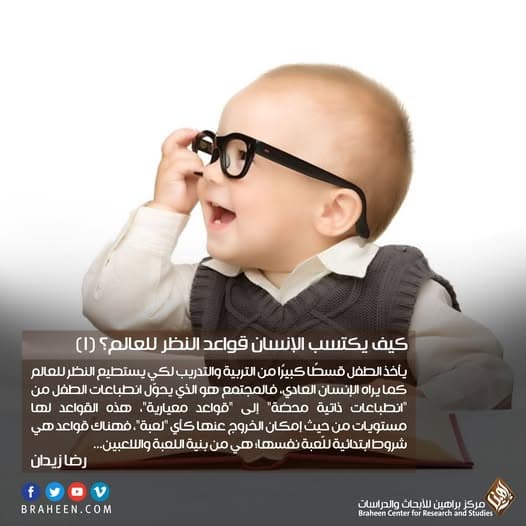
* Disclaimer: In this series we publish a summary of one of the chapters of the book (Human Consensus: Determinants and Criteria of Protest) by researcher Reza Zidane How does a person acquire the right habit and rules of looking at the world? The child takes a large part of education and training in order to...
* Disclaimer: In this series we publish a summary of one of the chapters of the book (Human Consensus: Determinants and Criteria of Protest) by researcher Reza Zeidan
How does a person acquire the correct habit and rules of looking at the world?
It is society that transforms a child's impressions from "pure self-impressions" to "normative rules", these rules having levels of deviability as any "game".[1] There are rules that are the initial conditions of the game itself; they are of the structure of the game and the players, and are rooted in their nature, namely the human commons (such as the principle of the regularity of the world in the form of simple laws such as causality).
There are rules that can be completely deviated, but this exit is the place of creativity and human art, such as the new metaphors that experimental scientists come up with in the construction of innovative theories, or metaphors very significant by which poets express the conscience of their society, and it is even incitement to society to look at something with this new metaphor, or modifications to children's games passed down through generations, which children themselves create with simple tools, from a child with a new outlook.
How does a child get rid of his subjective impressions and realize the meaning of “respecting the rules”? How does he change from playing free with things without “self-centered” rules to laws within a game he shares with his peers? There are no rules without a group, and why does he respect the rules in the first place?
The most important of these rules, which will affect all human activities is language; the child learns by any causal code such as the word "why" used in physical, social and subjective contexts to understand the meaning of "causality", but before entering into the value of mental firsts; we say briefly about the acquisition of rules in general:
There is a compound for teaching the child the rules (self-inclined to impose regularity on nature - adult education through eating and bedtime, for example - the repetition found in nature such as the succession of day and night and the succession of daily scenes that the child sees in his parents), the child from his first months swims in an atmosphere of rules, all this is enough to understand the rules or what Jean Piaget calls "the legal process".[3] This compound is a forced follow and optional follow stemming from the child's love of the child's of his upbringing.
One of the most famous innate rules are the mental firsts, and the nature of certainty in them, and is considered the most important issues in the theory of knowledge during the human heritage because it is the basis of knowledge, and because they are issues that can not be proven but are taken as Muslims and end the proof to them, the issue that the whole is greater than the part always can be demonstrated, but accepted by the child as a Muslim without consideration, Ibn Hazm says: The young boy in that if you give him two dates and a third secret. If he wants to go to a place, then I grabbed him forcibly crying, and he said something that means: Let me go, knowing that he is not in the place he wants to go as long as he is in one place.
Ibn Hazm - and the doctrine of mental - sees issues attacking the soul from mere friction with reality, "and not between the first times distinguish the soul in this world and the realization of all that we have mentioned the deadline at all, not a minute and no glaring and no way, revealing that they are necessities caused by God in the soul and there is no way to deduce."
Ibn Sina knows it by saying: The issues that are believed by man in terms of his mental strength, without a reason to believe them except for their own selves([6]), they are principles that are not established by sensory experience, but are an innate nature in man, and this is the reason for certainty in them, and must end inference as common ground between humans, otherwise the chain must be refrained from; Ibn Taymiyyah says:
The proof that gets the consideration of science must end to innate necessary introductions, all science does not necessarily end to intuitive science must end to necessary science, as theoretical introductions if proven by theoretical introductions always required tribal role, theoretical science is what happens by looking at the introductions of knowledge without consideration if these introductions are also a theory to stop it from others.
There are two classical doctrines of knowledge; the mental doctrine:
The mind is the source of knowledge and the reference for theories; the healthy senses are aware of the particles of knowledge but the mind is aware of the total knowledge that relates to existence as existence, because they are absolutely certain issues in any possible world, and the most famous representatives of this doctrine; Plato, Aristotle and Descartes.
Plato says of its recognition: Students of geometry and similar forms of thinking begin by adversarially handing over certain things, and treat them as basic assumptions.[8]
He says of its acquisition: the ability to understand facts is innate in every human mind.[9]
Looking at Menon’s interview, Plato insists on the foresight that exists in children or the ignorant in understanding the facts, the teacher only has to alert and remind of the right questions.
The empiricism of the mind has a white page, the child is born without any kind of tribalism, and then the friction of reality teaches him through sense, and the most famous representatives of this doctrine are David Hume and Stuart Mill and most of the materialist philosophy.
But I will not be exposed to the doctrine except through the idea of rules and certainty in it, because the main idea in this part is not the origin of knowledge but the securing of knowledge, whether there is a "mental structure" before dealing with the world obliges man to create rules or not, the outcome is a normative structure, that is, through measurement with most humans, The mental doctrine knew that it is an innate structure by comparison not by looking at the self "introspection", and did not secure these basic knowledge only by reference to the correct human habit.
The experimental doctrine is implicitly accepted that the reality "society" is the donor of awareness and structure that will be agreed upon by most humans; without this agreement there would be no experiences, whether material or social or psychological in the general sense, the subjective impressions that I talked about is not the "psychological human experience in the sense of pain, for example", because these experiences can not be based on experiences only, experience is possible only within the context of a fixed assumed, how can experience come true?
References:
[1] The term games will be discussed in detail.
[2] From that drawing in children and the overlap of their self-impression with the rules; see in this book: Introduction to the psychology of children's cartoons by Abdul Muttalib Amin Al-Qureiti.
[3] Jean Piaget, Moral Judgment in Children, Library of Egypt, translated by Mohamed Khairy Harbi, p.
[4] Ibid., p. 44, and see the following experiments.
[5] The introduction of the chapter in boredom, passions and bees.
[6] Ibn Sina, Survival in Logic and Divinity, Generation House, p.
[7] Prevention of mind conflict and transport 3/309.
[8] John Cottingham, Rationalism; Renewed Philosophy, Center for Cultural Development, translated by Mahmoud al-Hashemi, p:34.
[9] Ibid., p.
—
Source: Published on Facebook's "Braheen Center" page