
To kill malaria, chloroquine must enter and stay in the parasite's "stomach". In fact, the parasite captures the drug and concentrates it in its digestive vacuole by 10,000 times. The process is complex, and there are several ways to cut this...
To kill malaria, chloroquine must enter and stay in the parasite's "stomach". In fact, the parasite captures the drug and concentrates it in its digestive vacuole by 10,000 times. The process is complex, and there are several ways to cut through this route, resulting in drug resistance. Let's consider possible cases, without worrying about the complexity of mutations.
Perhaps the digestive gap environment could be altered slightly by making it less drug-friendly. Or maybe changing a protein pump that usually removes other things from cells, and making it expel the poison. Or maybe modifying some of the usual repair mechanisms of the cell in order to chemically sabotage chloroquine. Or maybe the sickle cell might only switch certain components of its membrane to stop the entry of the chemical. Or it might be announced as an alternative way to deal with the waste.
A group led by Thomas Wellems at the National Institutes of Health made the discovery through a series of genetic studies on the parasite. They first narrowed the search to one chromosome out of fourteen. More complex (and stressful) studies also narrowed the region of the resistant gene to a region of 400,000 nucleotides from that chromosome,3 and eventually to a region of six thousand nucleotides.
When he sequenced that gene, the workers were able to identify the amino acids in the protein they were seeking. It was like a needle in a haystack: one of five to three hundred proteins that DNA codes for a parasite.5 As biology progressed over the past few decades, scientists were able to learn a lot about the role that any particular protein in a cell was likely to play, by looking at its amino acid sequences only, and even before they had any experiments.
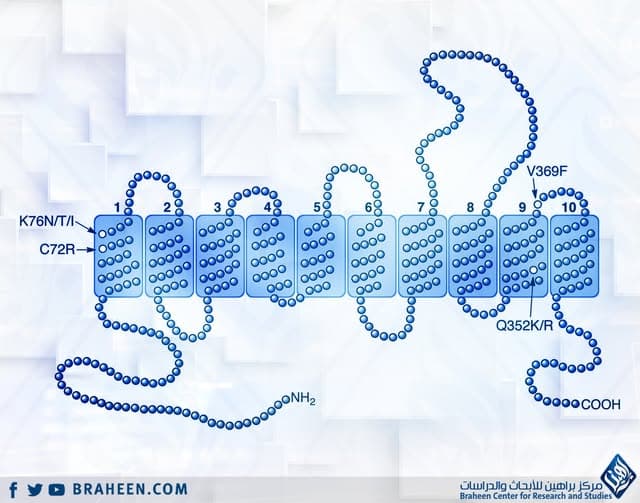
The sequence of that protein (called PfCRT for its p. falciparum chloroquine resistance trace) revealed that it contained ten separate amino acid extensions, which were hydrophobic or oily. This suggests that these regions will stick in a cellular membrane, the membrane itself being made of oily molecules, which prefer to come into contact with other oily molecules. Other regions of the PfCRT protein were less hydrophobic and may have popped out towards the water at one side of the membrane. Other proteins known to have such features help to form pumps and gates. Membranes in all living cells contain many different types of protein machinery that act as gates, allowing certain molecules such as nutrients or nutrients to pass in and out. The gates are sometimes passive, simply allowing the right-shaped molecules to float through on their own. Often, gates are active, i.e., they knock the right molecules through the membrane. Because a cell must deal with many different types of molecules that pass in both directions, it has many separate pumps and gates.
More: https://braheen.com/publications/حافة-التطور-البحث-عن-حدود-الداروينية
—
Source: Published on Facebook's "Braheen Center" page
https://www.facebook.com/braheen.org/posts/pfbid021NgaqJ7PMLdhepZvNwy5jpsEnnJME3btbX1X8mhgARhKx7z2gs8NUWHq9mwinQFyl