
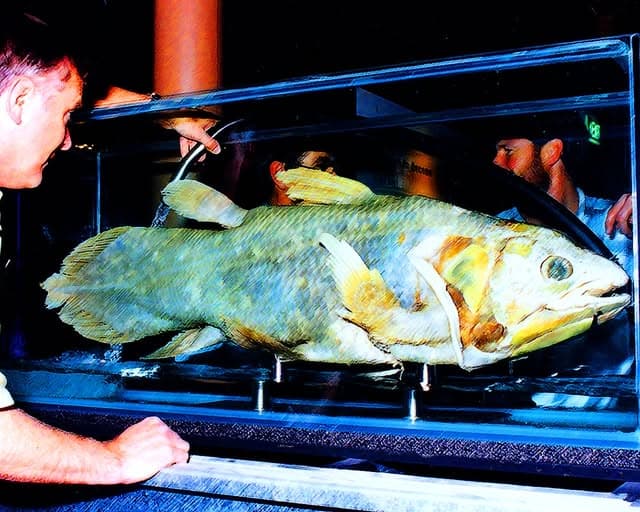
For nearly 100 years, ribids have been the typical ancestor of amphibians, and have been classified as a mediator between fish and terrestrial vertebrates. But in 1938, fishermen in the Indian Ocean on the coast of South Africa’s Cape province...
For almost 100 years, the Rapidstei have been the typical ancestor of amphibians, and have been classified as a mediator between fish and terrestrial vertebrates. But in 1938, fishermen in the Indian Ocean on the coast of Cape Province, South Africa, brought to the surface a nearby living creature of the ancient Rapidstei, which was an amazing discovery. It was thought to be extinct a hundred million years ago!!!
The previous rule was based on a number of structural features, including the shape of the skull bones, the structure of the teeth, the vertebrae, and also the pattern of the fin bones, which were all similar to the oldest known amphibians, and assumed that their soft structure would also be transitional between fish and amphibians.
Because coelacanths are so closely related to ribids, there has finally been an opportunity to biologically examine one of the classical evolutionary connections closely. The discovery has caused a stir, with Peter Forey commenting:
"We had to wait 100 years for the last discovery of the Coleacanth, during which time many fossils of the Coleacanth were described based on their orthopedic properties, their taxonomic position as the closest living organism to the extinct ribistic fish and as the cousin of the tetrapods as an evolutionary fact, now immortalizing that fact in textbooks. Finally, a glimpse of the way of life of the ancestor of tetrapods was given, and these predictions were based on two premises: first, that the ribdest fish were closest to the tetrapods, and second, that the lattice was derived from the ribdest fish."63
But tests on live colacanths have disappointed all expectations; many of its anatomical structures, particularly the heart, intestines, and brain, were not as expected for the progenitors of tetrapods. As Barbara Stahl writes:
"Modern coelacanths show no evidence of having internal organs pre-prepared for use in a terrestrial environment. The cerebrospinal lesion of fish is present in terrestrial animals, but it is vestigal in lattice. The vein that transports blood from its wall does not return it to the left side of the heart as in tetrapods, but to the cerebrospinal sinus as in bony fish except for pulmonary fish.
Clearly, if the soft structures of ribidic fish are somewhat similar to their coelacanth cousins, then no matter how much they are similar to the oldest amphibians in structural traits, they must be far removed from their biology as a whole. Of course, it can always be claimed that the structural similarities between these colacanths and ribidic fishes are a product of convergent evolution, but that is why they are so similar.
The case of coelacanth explains how difficult it is to make inferences about the biology of organisms in general through their bony remains alone, and because the soft structures of extinct groups cannot be known with any degree of certainty, it is self-evident that even the most convincing intermediate form cannot be reassuring. Colacanth is another example of the discovery of a new species, which may have provided us with elusive evidence of the transitional forms that evolutionary biology has sought for so long.
More: https://braheen.com/publications/التطور-نظرية-في-أزمة
—
Source: Published on Facebook's "Braheen Center" page