
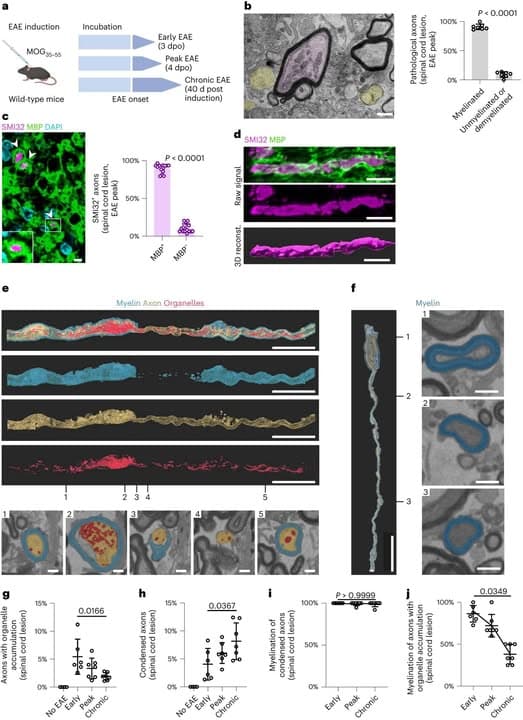
At the end of last month (June 2023) a German research group in a recent paper in the journal Nature Neuroscience made a new contribution to trying to understand the pathology of multiple sclerosis, which may significantly change our understanding of the nature of the disease.
At the end of last month (June 2023) a German research group in a recent paper in the journal Nature Neuroscience made a new contribution to trying to understand the pathology of multiple sclerosis, which may significantly change our understanding of the nature of the disease.
It is already known that the degree of occurrence of antigens in the axons determines the clinical outcome in multiple sclerosis, an autoimmune disease in which immune cells attack the myelin envelope surrounding the axons of neurons and remove it (and therefore it is an autoimmune and demyelinating disease). The disease has been affecting some 8 million people worldwide and has seen a significant increase in the number of people affected by it.
Myelin is widely considered a protective axon of multiple sclerosis. Myelin-coated axons also rely on oligodendrocytes, which in turn provide metabolic and structural support to the axial compartment.
Given that axonal dystrophy in multiple sclerosis has already been detected in the early stages of the disease, by even removing pronounced myelin, the researchers suggested that autoimmune inflammation disrupted the mechanisms of oligodendroglial cell support and thus directly affected the axons isolated by myelin.
The researchers also studied axonal dystrophy as a myelin-forming activity in human multiple sclerosis, autoimmune myelitis, and autoimmune brain and mouse models with a genetically modified myelin-forming process.
The paper provides a literature survey of previous studies that investigated the role of myelin in the survival of the axon and degeneration in multiple sclerosis. The authors note that oligodendrocytes provide more than just electrical insulation of the axons, and that the long-term integrity of the axon critically depends on the health of oligocytes, a finding originally derived from studies of myelin mutations.
The authors also suggest that oligodendrocytes provide nutritional support to the axon because the axons are isolated from extracellular glucose at least partially by myelin itself. In addition, oligodendrocytes contribute to antioxidant defense and protect neurons from cellular toxicity. The authors suggest that autoimmune inflammation may disrupt oligodendrocytes' support mechanisms and thus primarily affect myelin-insulated axons.
The researchers concluded that myelin encapsulation itself becomes harmful to the survival of the axon in an autoimmune environment and increases the risk of its degradation. This thus challenges the idea that myelin alone is a protective structure and suggests that the dependence of the axon on low-depotency glial support can become fatal when myelin is exposed to an inflammatory attack.
—
Source: Published on Facebook's "Braheen Center" page