
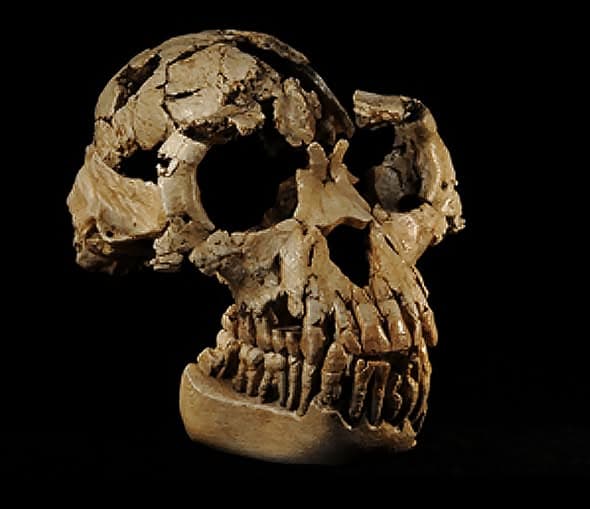
In 2009, the journal Science announced a long-awaited, 4.4-million-year-old fossil of the ape Ardi, Ardipithecus ramidus. Its discoverer, paleoanthropologist Tim White of the University of Berkeley, raised his expectations…
In 2009, the journal Science announced a long-awaited, 4.4-million-year-old fossil of the ape Ardi, Ardipithecus ramidus. Its discoverer, paleoanthropologist Tim White of the University of Berkeley, raised expectations by describing it as “an exceptional ape that could serve as a Rosetta Stone for unraveling the mystery of walking on two legs.” (41)
Once the paper was published, the scientific community preached to the public the truth of Darwin’s view.
The Discovery Channel announced the discovery, titled "Arde, the discovery of the earliest ancestors of humans", and then quoted Tim White as saying, "How close we are to finding our last common ancestor with chimpanzees."[42] The Associated Press published the news, "The discovery of the structure of the oldest transitional ancestor of humans," and stated under the title, "The new discovery provides evidence for the evolution of humans and chimpanzees from one ancient common ancestor."[43]
Calling this fossil a novelty is a faulty linguistic choice by Science magazine; given that Ardi has been discovered since the early 1990s, why has Ardi's detection been delayed for more than 15 years?
An article in Science magazine in 2002 explained that the fossil's bones were broken, tender, crushed and chalked, and White, its discoverer, said: "When I cleaned one of its edges, the edge was eroded, so I had to mold each of the broken pieces into a mold to rebuild the fossil."
The same is stated in other reports that "some parts of the skeleton were found crushed into crumbs and a lot of digital virtual recombination had to be done," "The pelvic bone was like soup."[47]
A 2009 Science magazine report tells a startling story about the fossil’s poor quality: “The team that discovered the fossil lost their enthusiasm because of its terrible condition, the bones were broken up just by being touched, even as if they had died trampled on the road, parts of the skeleton were crushed and scattered for over 100 pieces, and the skull was crushed to a height of only 4 cm.”
In an article titled "The Discovery of the Older Skeleton of the Ancestors of Mankind", the scientific editor of the National Geographic said: "Ardey's body was buried after dying in the mud under the feet of hippos and other herbivorous animals, and millions of years later, erosion and erosion brought the shattered skeleton to the surface.
We must carefully measure the shape of the various bones to claim that an organism of the great ape species was walking on the ground on two legs, how can we if we trust the claims about Ardi to be "a rational stone in understanding the state of walking on two legs" if the bones are broken by gestures and turn to dust by simply touching them?!
Many skeptical human paleontologists consider these claims to be unbelievable, and as reported in the journal Science: "Many researchers do not trust these findings, some doubt the fact that the fractured bones of the pelvis show the anatomical details necessary to prove walking on two feet, and says the human paleontologist Carol Ward, from the University of Missouri, Columbia, that the pelvic bones at best suggest walking on two feet and can not confirm it, and that the monkey's are not shown. To cut into the form of the human being according to my opinion."
In a paper in the journal Science, primatologist Esteban Sarmiento says: "All the traits said to suggest that the ape was walking on two legs are necessary for an animal to walk on four feet, and the piece of foot found for the ape is functionally close to the foot of the gorilla, a terrestrial or semi-terrestrial animal that walks on four feet and does not walk on two feet optionally."
When the ape was first introduced, Bernard Wood said, "I think the head is in agreement with the animal being in the group of humans, but the rest of the body is more questioned."52 Two years later, Wood co-wrote a paper in Nature detailing these criticisms, and said, "If the ape is still the ape of a human and one of the ancestors of modern humans, it means that the fossil has a high degree of affinity."
According to an article in ScienceDaily discussing Wood's paper in Nature, "the claim that Ardey is one of the ancestors of humans is a very simple and concise claim to the truth of what happened."[54] As Stanford anthropologist Richard Klein puts it, "I don't think that Ardey was one of the great apes at all or that he was walking on two legs."[55]
In an interview with Time magazine, Sarmiento said, "Tim White gave no evidence that Ard belonged to the evolutionary lineage of humans; the traits that White spoke of as human are also present in apes and in ape fossils that we consider not to belong to the evolutionary lineage of humans."
White's biggest mistake, according to the paper, was to use archaic features and principles in classifying Arde and failing to identify anatomical glimpses that distance Arde from the human line. Sarmiento provides an example of this from the Arde skull, as the inner surface of the jaw joint is open, as in the case of orangutans and gibbons, and not fused to the rest of the skull, as in humans and African monkeys, suggesting the separation of the Arde line.
Whoever Arde is, everyone agrees that this fossil is very fragile and needs extensive reconstruction, yet the discoverer of this fossil fancies that it belongs to one of the ancestors of humans or something close to it, and that he was walking on two legs, no doubt this controversy will continue, but are we obliged to believe the broad claims made by Arde discoverers in the media?
Sarmento does not believe this, and according to Time magazine he considers the "media hype accompanying Ardi to be overblown".
More: https://braheen.com/publications/العلم-وأصل-الإنسان
Sources:
(41) Tim White, quoted in Ann Gibbons, “In Search of the First Hominids,” Science, 295 (February 15, 2002): 1214–19.
(42) Jennifer Viegas, “‘Ardi,’ Oldest Human Ancestor, Unveiled,” Discovery News (October 1, 2009), accessed March 4, 2012, http://web.archive.org/.../history/ardi-human-ancestor.html.
(43) Randolph E. Schmid, “World’s oldest human-linked skeleton found,” MSNBC (October 1, 2009), accessed March 4, 2012, http://web.archive.org/.../worlds-oldest-human-linked.../.
(44) Ann Gibbons, “Breakthrough of the Year: Ardipithecus ramidus,” Science, 326 (December 18, 2009): 1598–99.
(45) Ann Gibbons, “A New Kind of Ancestor: Ardipithecus Unveiled,” 36–40.
(46) Gibbons, “In Search of the First Hominids,” 1214–19.
(47) Michael D. Lemonick and Andrea Dorfman, “Ardi Is a New Piece for the Evolution Puzzle,” Time (October 1, 2009), accessed March 4, 2012, https://content.time.com/.../article/0,9171,1927289,00.html.
(48) Gibbons, “A New Kind of Ancestor: Ardipithecus Unveiled,” 36–40. See also Gibbons, The First Human: The Race to Discover our Earliest Ancestors, 15 (“The excitement was tempered, however, by the condition of the skeleton. The bone was so soft and crushed that White later described it as road-kill”).
(49) Jamie Shreeve, “Oldest Skeleton of Human Ancestor Found,” National Geographic (October 1, 2009), accessed March 4, 2012, https://www.nationalgeographic.com/.../oldest-skeleton....
(50) Gibbons, “A New Kind of Ancestor: Ardipithecus Unveiled,” 36–40.
(51) Esteban E. Sarmiento, “Comment on the Paleobiology and Classification of Ardipithecus ramidus,” Science, 328 (May 28, 2010): 1105b.
(52) Gibbons, “A New Kind of Ancestor: Ardipithecus Unveiled,” 36–40.
(53) Wood and Harrison, “The evolutionary context of the first hominins,” 347–52.
(54) “Fossils May Look Like Human Bones: Biological Anthropologists Question Claims for Human Ancestry.”
(55) John Noble Wilford, “Scientists Challenge ‘Breakthrough’ on Fossil Skeleton,”New York Times (May 27, 2010), accessed March 4, 2012, http://web.archive.org/.../2010/05/28/science/28fossil.html.
(56) Eben Harrell, “Ardi: The Human Ancestor Who Wasn’t?,” Time (May 27, 2010), at https://content.time.com/.../article/0,8599,1992115,00.html.
(57) Ibid.
—
Source: Published on Facebook's "Braheen Center" page
https://www.facebook.com/braheen.org/posts/pfbid0tgmZ7RHunM9Sxx5VrqGSxBEXgmAYywcRSZ8exKf3AMmi8QAtiBm4JZLuGAMA7Juql