
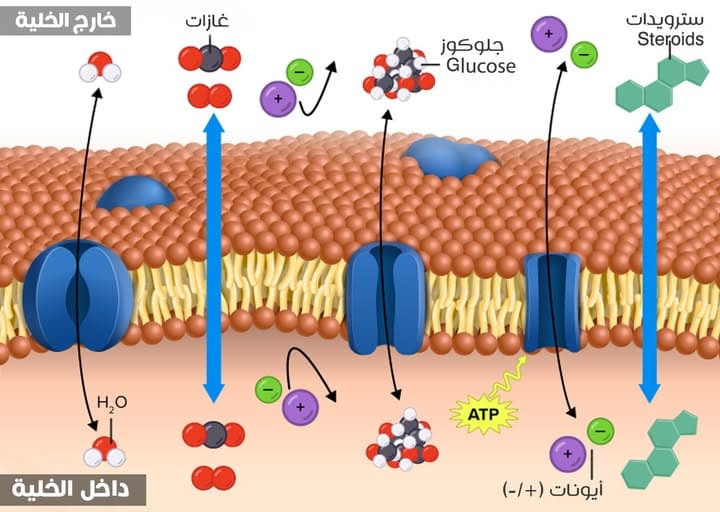
The cell membrane is one of the most important structures in the cell, and consists largely of fat, and it is difficult to imagine the survival of the cell without some kind of surrounding membrane relatively non-permeability of the components of the cell - especially for small metabolites such as sugar...
The cell membrane is one of the most important structures in the cell, consisting largely of lipids, and it is difficult to imagine the survival of the cell without a type of membrane surrounding the relatively unperturbed semipermeability of the cell's components - especially for small metabolites such as sugars and amino acids - to prevent their proliferation outside the cell to the surrounding fluid. This membrane must also be relatively flexible, and able to maintain a continuous barrier between the cell and its environment in its altered form.
The bi-lipid layer meets these criteria admirably; its hydrophobicity meets the criterion of being impervious to most components of the cell, such as sugars, amino acids and other organic acids dissolved in water, and it has exactly the property of the fluid necessary to maintain a continuous barrier surrounding the constantly moving and turbulent cytoplasmic mass, as it is very fluid and has a viscosity similar to olive oil.
The structure of the bi-lipid layer is shown in the following figure. Note that the lipids that make up the membrane are phospholipids, which are lipids with a charged phosphate group at one end, and the hydrophilic end, while the hydrophobic end is hydrophobic, and when the hydrophilic phosphate groups gather on themselves, the hydrophilic ones head towards the water, while hydrophobic hydrocarbon chains head away from it.
One factor that contributes to this remarkable structure is that it spontaneously forms around the outer surface of the cell, such as the diffusion of a thin, single-molecule layer of a substance that is not mixed with water mostly lipids on its surface. Cell biologist John Trinkaus comments: "Because water is a strong polar molecule, the polar phosphate group in the membrane lipids is attracted to the membrane's two layers.
There is no other known substance that can replace this particular structure, and the properties of amorphousness, fluidity, and spontaneous assembly seem to be essential qualities in any membrane system surrounding the cell, but this unique combination of traits is only found in the lipid bilayer, and here is another case in which a basic biological function is ideally and seemingly uniquely suited to its specific role.
Another property of the lipid bilayer, which is inherent in its hydrophobic nature, is that it is electrically insulating, because it is impermeable to charged particles, such as sodium ions (Na) and potassium (K), thus it is able to restrict its movement through the membrane to specially designed ion gates, and the cell is able to generate electrical potential between inside and outside the cell, known as membrane ion.
If the lipid bilayer is not insulating, the cells will not be able to maintain their membrane latency, and many biological phenomena dependent on membrane latency will not be possible, such as the transmission of nerve impulses. In addition to their insulating properties, the lipid bilayer is suitable for generating membrane latency in another way, providing an ideal environment for membrane proteins, which pump ions into and out of the cell, where proteins reside and function in that double layer.
This characteristic of this wonderful structure, which is the character of electrical insulation and the membrane potential that it generates automatically, will provide the electrical properties required specifically to transmit nerve impulses between cells, and to build the nervous system in the end, which is certainly a fact and coincidence of great importance, no less important than its electrical and insulating properties, and its ability to self-assembly, the nervous system itself is already considered a (bilateral fat layer fungus).
The electrical properties of the cells depend on many other factors in addition to the insulating properties of the lipid membranes, where the spread of nerve impulses depends, for example, on the rapid transfer of depolarization waves along the nerve fiber, and the depolarization speed itself is caused by the rapid spread of sodium and potassium cations through special gates in the nerve cell membrane, and this process is greatly enhanced by the low viscosity of water, and by the unique properties of the cations themselves.
Dr. Michael Denton, The Fate of Nature: The Laws of Life Reveal the Existence of Purpose in the Universe, Center for Evidence 2016, pp. 329
https://braheen.com/publications/قدر-الطبيعة-قوانين-الحياة-تفصح-عن-وجود-الغاية-في-الكون
—
Source: Published on Facebook's "Braheen Center" page