
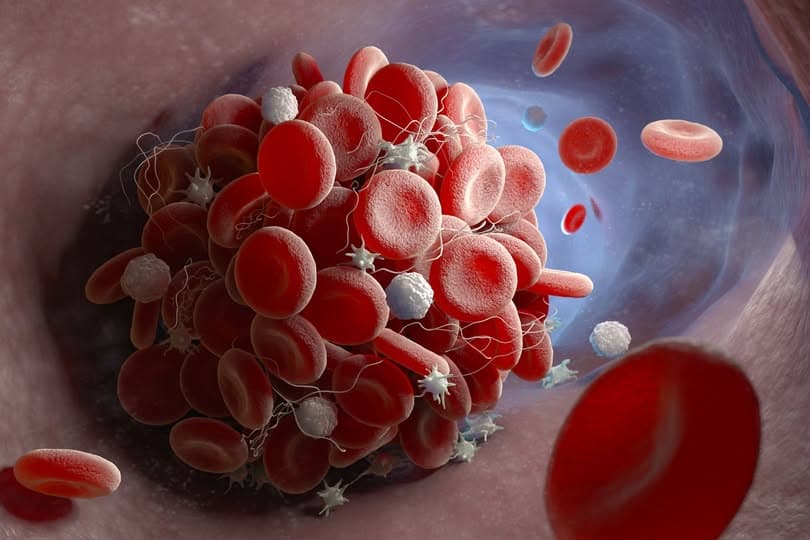
Let's now take some time to do an important research into Doolittle's evolutionary scenario of blood clotting. The first thing to note is that it does not mention the presence of causative factors. Where we note the following: The histological factor appears, fibrinogen is generated and an...
Now let’s take some time to do an important research into Doolittle’s evolutionary coagulation scenario. The first thing to note is that it doesn’t point to causal factors. We observe: the histological factor appears, fibrinogen is generated, antiplasmin is created, TPA is released, a protein with reciprocal bonds is released, and so on. Doolittle seems to have in mind a “step-by-step” Darwinian scenario involving random indirect replication and recombination. But consider the sheer luck required to get the right genetic pieces in the right places. Eukaryotic organisms have very few genetic pieces, and the process they exchange seems to be random. Creating a new blood clotting protein by mixing is like randomly picking dozens of sentences from an encyclopedia in the hope of forming a coherent paragraph. Doolittle did not bother to count the number of different incorrect, ineffective, and useless mixed fields that would be excluded before, for example, obtaining a protein with TPA-like activity.
To illustrate the problem, let's do our own quick calculations. Consider that organisms with a blood-clotting waterfall have approximately 10,000 genes, each divided into about three pieces. This gives us a total of approximately 30,000 genetic pieces. TPA has four different types of sites.7 By mixing multiples, the chances of having these four sites together(8.) are about 1 in 10,000 times the age of four, which is about 1 in 18. Doolittle's spontaneous language (as the term "spring forth", etc.) hides enormous difficulties. The very small chance problem itself may also hinder the emergence of the thrombin protease (the result of the doubling of the protease gene and then mixing), fibrinogen (an illegal protein derived from), plasminogen and axylene protease, all of the many suggested forms of rearrangement of the thrombin protease. Dooly needs to mix and cooperate with the best scientific hands to succeed.
The implicit claim that a protein made from the duplicate gene might immediately have the new necessary properties is also taken into account. So they told us that it shows the histological factor as a result of the replication of one gene – another protein – but certainly not the histological factor as a result of the replication. Maybe this applies to the other protein.
To illustrate the meaning of the word multiplication, imagine that a lab for making bicycles has doubled, and then it will still make two progenitor proteins and not motorcycles. The protein gene may be multiplied by a random mutation, but it will not just happen in order to have complex new properties. Since the duplicate gene is simply a copy of the old gene, the explanation of the appearance of the tissue factor must include an imaginary pathway that leads to the acquisition of a new function.
The third problem with the blood clotting scenario is that it did not address the important issues of quantity, speed, time and space. Nothing is said about the amount of clotting material initially available, the strength of the clot that may be formed by a simple system, the time it takes for the clot to form as soon as the wound occurs, the flow pressure that the clot may resist, the damage caused by the formation of inappropriate clots, and several such questions. The absolute and relative values of these or other factors may make any particular hypothetical system either possible or more likely a terrible error. For example, if only a small amount of fibrinogen is available, it may not be enough to cover the wound; if the initial fibrin forms a random point rather than a network, blood flow cannot be stopped. If the initial action of the antithrombin is too fast, and the initial action of the thrombin is too slow, or if the association of the original Stewart factor, christmas factor, or antihypertensive agent is too weak or too tight, or if it is associated with inefficient forms of its targets as well as effective forms, then the whole system will collapse. What Doolittle did is not a science because at no stage, not even one, came up with an example based on numbers and quantities, and without numbers there is no science. If such a complex system evolved simply by way of an oral image, there would never be a way of knowing if it actually worked. When you ignore such important questions, we get out of the box and into the world of cartoons (Calvin and Hobbes).
The objections raised so far are not the most serious, but the most serious, and perhaps the most obvious, about irreducible complexity. I assert that natural selection, the engine of Darwinian evolution, works only if there is something to choose, something that is useful now, not in the future. Even if we accept Doolittle’s scenario, he himself says that blood clotting doesn’t appear until at least after stage three. The formation of the histological factor in the first stage is unjustified, because then he will sit without a job, and in the next stage you will not find the pro-thrombin of the poor what it does - it appeared before the histological factor but has the ability to bind, where it does in some way - and in the end, the virtual therombin receptor appears in the third stage and highlights fibrinogen in the fourth step. Plasminogen appears at one stage but TPA does not appear until two later stages. A sturate agent appears on the platform at one stage, but does nothing until a convertin is activated at the next. The histological agent is somehow related to this complex. Almost every stage in this proposed pathway faces the same problems.
Simple words like “the activator doesn’t appear until two stages later” don’t seem exciting until you consider their implications because each stage along the way requires two proteins – the avant-garde and the activated enzyme – and here the chances of getting the two proteins together are almost the square root of the chances of getting one. We calculated the chances of getting TPA alone and found it to be one to ten for the 18th power, and we found the chances of getting TPA activated together about one to ten for the 36th power; it's a terrifyingly large number. Such an event is not expected even if we give Earth instead of every second of its life (estimated at 10 billion years) 10 billion years. But the worst case is already the following: If a protein appears at one stage(10) where it has no role, then the mutation or natural selection will tend to get rid of it, and since it has no significant effect, losing it will not be harmful, but will cost the production of a gene and protein energy that other organisms do not spend. Thus the production of an unhelpful protein is at least to a secondary degree harmful. The Darwinian mechanism known as natural selection may actually hinder the formation of an irreducible complex system such as the coagulation cascade system.
Doolittle implicitly admits in his scenario that the clotting cascade is irreducibly complex, but he tries to cover the dilemma of figurative cues for yin and yang. The bottom line is that a batch of proteins must be introduced into the clotting cascade.
Based on Professor Doolittle’s example, we can assume a path in which the mousetrap is first constructed: the hammer appears as a result of doubling two levers in our back pantry, then the hammer connects with the base, and as a result of mixing some wooden sticks, a spring jumps from the old grandfather clock that was used as a timekeeping device, then the installation beam comes from a straw coming out of a soda can, and the tweezers come from the lid of a beer can.
Doolittle’s audience, published in the journal Thrombosis and Haemostasis, is the pioneers of coagulation research, as they are aware of the latest developments, but so far the article has not explained to them how coagulation arose and how it evolved; it only tells a story.
- Dr. Michael Behe.
—
Source: Published on Facebook's "Braheen Center" page