
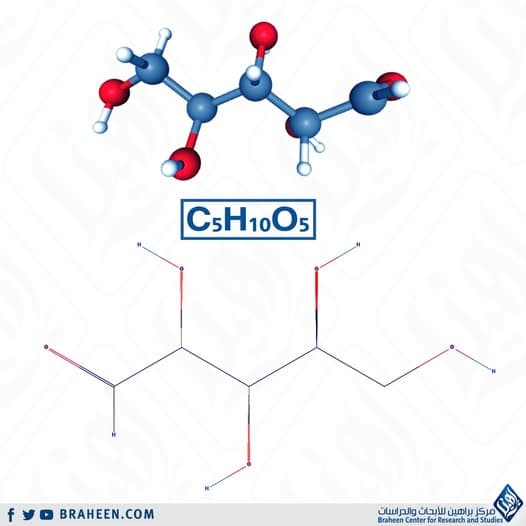
Sugars are one of the major fuel molecules used in all systems of life, and the figure illustrates the chemical composition of pentacarbon arabinose sugar. In chemistry parlance, sugar represents a halfway point in the carbon oxidation process between...
Sugars are one of the major fuel molecules used in all life systems, and the figure illustrates the chemical composition of pentacarbon arabinose sugar.
In chemistry, sugar is a midway point in the carbon oxidation process between C18H36O2 (almost completely reduced carbon) and CO2 (completely oxidized carbon); sugars are highly reactive compounds, and have a tendency to spontaneously oxidize, but in the case of pentavalent and hexavalent carbons, this reaction is impaired by their characteristic ring structure or relatively stable cyclic structure.
David Green and Rob Goldberger R. F. Goldberger comment:
"The glucose ring is curly, its carbon atoms are bound by axial and equatorial axial groups, and an understanding of the unique structural features of glucose is now possible, with all the large and massive groups being tropical, while no other hexagonal sugar has this particular feature, as they all have at least one large axial group, which means glucose is the most stable hexagonal sugar."1
A. E. Needham notes that the stability of hexacarbons, as well as their self-reactiveness, “undoubtedly explain the prominent biological role of hexagonal sugars, which break down slowly when they are in crystal form or in highly concentrated solutions that are not ingested by living organisms. On the other hand, once activated quickly, they are oxidized in an explosive manner, and are an ideal fuel for use.”2
Glucose and other hexagonal sugars have essential advantages: in addition to their simple chemical nature, glucose sugar is ideally suited to its intrinsic biological role as the "circulating currency" of the cell's energy system, it is also non-volatile (not lost by evaporation), highly soluble in water, and small enough to spread rapidly throughout the cell.
- Dr Michael Denton.
—
Source: Published on Facebook's "Braheen Center" page